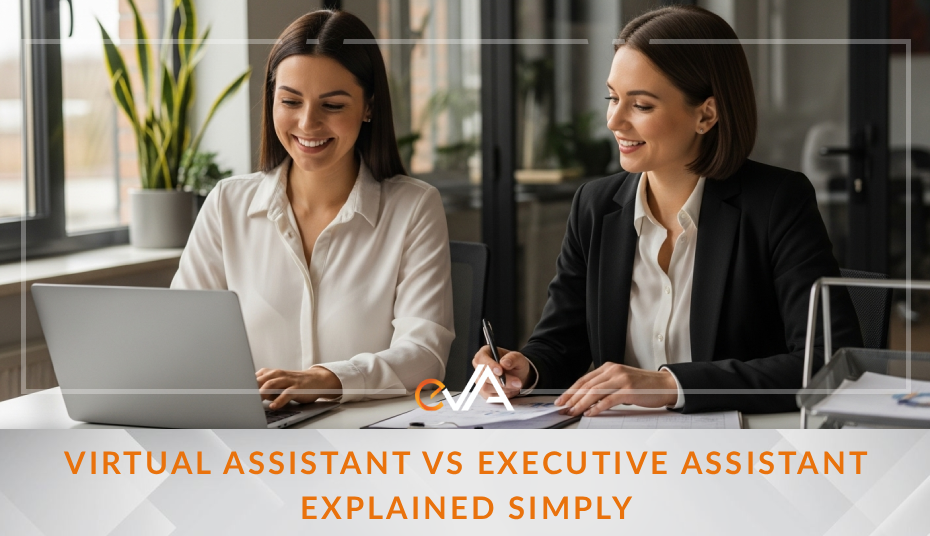
Virtual assistants and executive assistants both help you get more done, but they support you in different ways and are best for different stages of growth. Knowing the difference makes it much easier to hire the right kind of help for your business.
What each role actually does
A virtual assistant (VA) is usually a remote, part-time professional who handles repeatable, task-based work such as inbox triage, scheduling, basic customer support, data entry, research, and social media or content support. Their work is often process-driven and supports an individual, a founder, or even an entire team rather than only one executive.
An executive assistant (EA) typically supports one senior leader and works much closer to the “brain” of the business, handling complex calendars, board-level communication, prep for key meetings, and follow‑through on strategic projects. EAs are often full‑time, more embedded in leadership, and act as a trusted extension of the executive in decision-making and relationship management.
Key differences explained simply
- Scope: VAs focus on clearly defined tasks; EAs manage outcomes and projects that often have moving parts and higher stakes.
- Proactivity: VAs usually wait for instructions, while EAs anticipate needs, “see around corners,” and flag issues before they land on your desk.
- Level of access: VAs work mainly in operations and general admin, but EAs regularly handle confidential information, leadership communication, and high‑level priorities.
- Structure: VAs are commonly remote, flexible, and part‑time, whereas EAs are more likely full‑time and closely tied to an executive’s daily rhythm.
From a cost perspective, virtual assistants are usually more affordable and easier to scale up or down, while executive assistants command higher salaries or rates because of their depth of experience and strategic value. Businesses often start with a VA for admin relief and later add an EA when leadership needs a true operations and strategy partner.
Which one do you actually need?
Choose a virtual assistant if you mainly need help clearing your plate of recurring tasks like email clean‑up, appointment setting, CRM updates, content formatting, or basic bookkeeping. A VA is ideal when your biggest pain point is time spent on admin rather than decisions, strategy, or stakeholder management.
Choose an executive assistant if you are a founder, CEO, or executive who needs a right hand for complex calendars, meeting prep and follow‑up, executive communication, and driving key projects to the finish line. An EA makes the most sense when you want someone who understands your priorities deeply enough to say “no” on your behalf and protect your time.
If you’re feeling the weight of your to‑do list but not sure whether you need a virtual assistant or an executive assistant, start with a conversation. Share where your time is going, what keeps getting pushed to “later,” and what a perfect workweek would look like. Then, explore a flexible virtual assistant service that can take low‑value tasks off your plate today and grow with you into more strategic executive support as your business scales—so you stop working in the weeds and get back to leading your company.
What to read next: Essential Skills Every General Admin VAs Needs